
“What sort of things have you gotten out of being a part of the Men’s Shed?”
I realized the crudity of the question only as it left my lips. A response of equal bluntness was only appropriate.
“Something to do on Friday mornings, from ten to noon.”
I was sitting with John Lennig and Randall McKinnon under the bright retail lights of Kingsgate Mall, where the Mount Pleasant Men’s Shed was holding an expose. Without absolving my journalistic greenness, this instance serves as a case in point of the difficulties of directly talking about mental health, to which the very idea of a Men’s Shed owes at least partially its raison d’être.
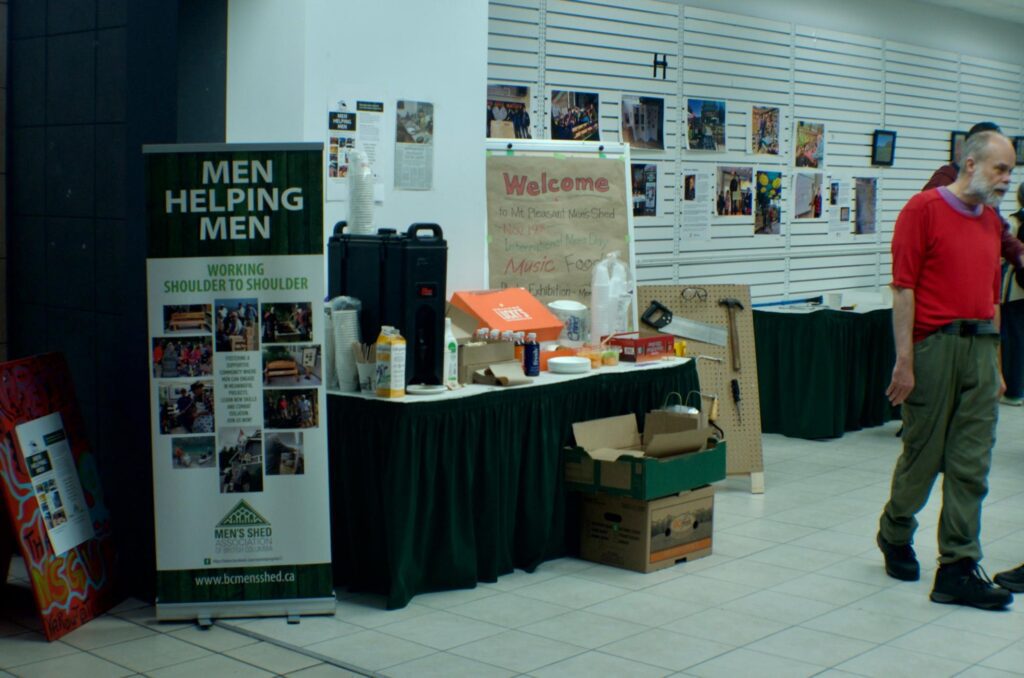
The first Men’s Sheds cropped up in Australia in the early 90’s, as local community-based organizations that offered retired men opportunities to socialize whilst working on projects together, centered around the idea that collaborative physical work improves well-being.
Luckily for me, John and Randall were patient and I was able to reformulate my question. Their responses suggested the idea might be working.
Randall explained that the most valuable part of being in the Men’s Shed was “getting to know people that I wouldn’t otherwise have gotten to know.”
John corroborated this, adding that the Shed provided the “possibility to do something that you know you’re versed in,” and that while being retired isn’t a requirement to join, it offers those who are “a chance to use those skills.” In addition to the ability to put his sign-painting talent to use, John has found in the Shed opportunities for connection beyond mere trade-sameness, which is especially valuable as “sign painters are far and few between.”
The value of this opportunity to socialize was a constant theme in all of the conversations I had, no matter how differently it was expressed.
In a written response, Harvey Chiang noted the importance of the routine weekly check-ins, and that “coming to listen to other people share their feelings and concerns is the rebounding process that masculinity and lone ranger male types are much better served by.”
Indeed, there is a certain clash between traditional stoic ideals of masculinity and the increasing awareness that mental health challenges should not be taken on alone. And yet recognizing this does not erase the difficulties of reaching out. What, perhaps, might, is knowing that reaching out can take many different forms.
And, unlike clinical mental health counseling, the experience need not be so one-dimensional.
Of course, communication is the essential element in overcoming mental health challenges, and the Men’s Shed suggests this can be done “shoulder to shoulder,” while simultaneously serving the community.
In addition to the model train set whose wanting of a coat of paint initially harkened him, John mentioned other endeavors undertaken by the Shed like constructing community gardens or helping to clean out the garage of a recent widow. And yet the outward ethos of well-being through physical labor by no means precludes the more Socratic connections that are made during behind the scenes planning.
In the handful of Men’s Shed meetings I sat in on I was treated to discourse on topics ranging in diversity from the threat posed to culturally significant architecture by commercial development to the absurdity of the fact a cup of coffee could cost six dollars. Some discussions were much heavier, much more personal. Yet what remained constant all throughout was the certainty that anyone who had something to say would also have an audience to listen.
Explicit discussions of mental health are not uncommon, though they are not a structured part of the meeting schedule. These discussions arise ad hoc, and their natural emergence allows them to be discussed in earnest, shirking the sterilized psychiatric connotations of seeking mental health support that might dissuade one from opening up.
Though the cumulative sum of my time spent with the Shed cannot be compared to the years that some of the senior members boast, I can surely say that I caught a glimpse of that indescribable and inexplicably valuable thing we call “human connection.”
John and I discovered that we traced the same route to get to Vancouver, from Oakland, save for a few decades in between. Frank introduced me to dragon’s eyes and taught me the innumerable unexpected ways that one could compound the Chinese character for pouch into new word meanings. Harvey, himself a UBC alumnus, was curious to hear how things had changed in his old stomping grounds.
More than an opportunity to cathartically brush shoulders or discuss emotions, the Men’s Shed offers one a place in the lives of others, a concrete meaningfulness that no internal strife can ever justifiably deride.
The last meeting I sat in on ended inconclusively on the topic of how to give back during the holidays. Shortly after it was adjourned, I had a conversation with Frank, who reminded me that more than any material goods, what would really make someone’s day would be being seen, being recognized.
In a way, this principle of placing indescribable human connection above inherently describable human artifacts finds a parallel in the fundamental idea of the Men’s Shed itself. The crisis of mental health cannot be simply argued away, it will require a collective and practical approach to be overcome.

Interviews and the article by Morris Hayes
Student of Sociology at UBC
Nov. 19th, 2025 International Men’s Day
Kingsgate Mall, Mount Pleasant, Vancouver